India Is Paying to Feel Less Alone. And Business Is Booming
Updated: Jun 19

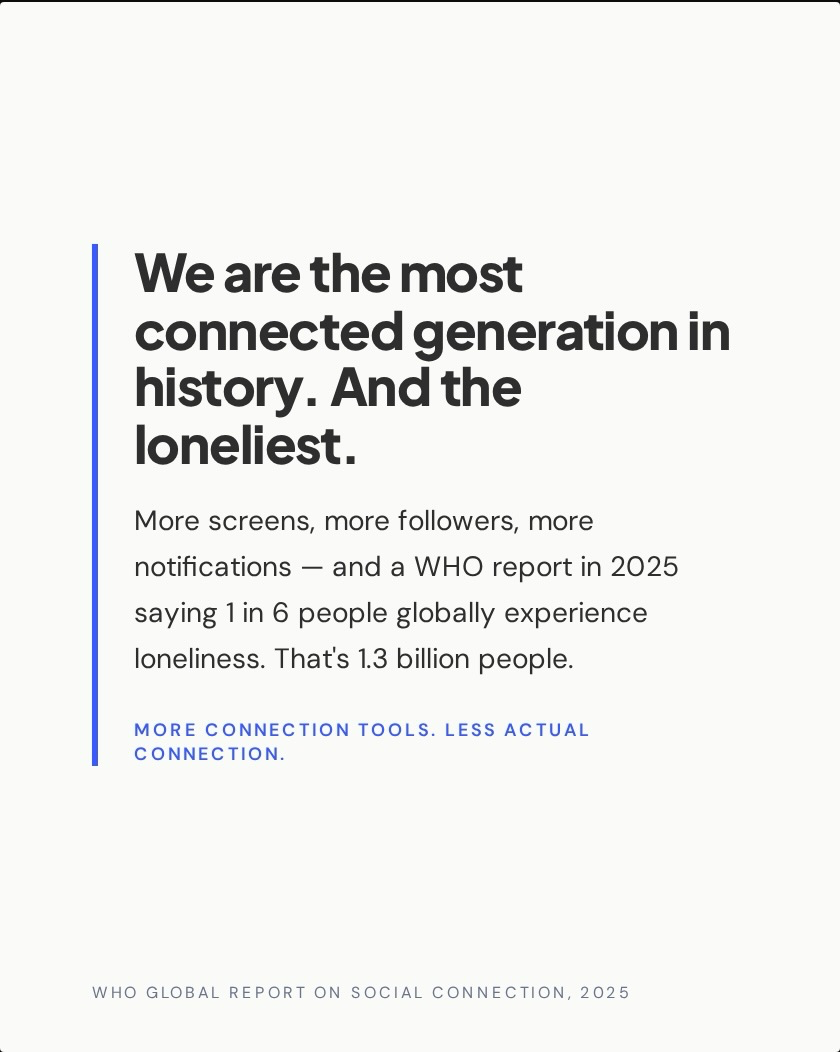
That number will stop you cold. 1 in 6 people globally experience loneliness — that's 1.3 billion people. India's youth score a painfully low 33 out of 100 on the Mental Health Quotient. AI companion apps have surged 700% in just three years. And 871,000 people die every single year from loneliness-related causes. Somewhere in the present times, at this very moment, a startup has just right now started out its first round of funding in order to be your friend—for ₹1,600 a month. We are the most connected generation in terms of human history. But also without any questions asked, we are the loneliest ones. Loneliness has been literally killing us. The algorithm has been built on the perfect system, which has engagement and also has accidentally dismantled its belonging. And India? India is paying to fill that gap. Business is booming.
We're not just talking about a wellness trend. We're talking about an entire economy that is built on human disconnection—and a generation has been quietly feeling lonely, feeling anxious, and also running out of time to put all of this together.
Does any of this sound familiar? You're not broken. You're part of a much bigger picture that nobody is talking about honestly.
Not anymore. Let's finally talk about that.
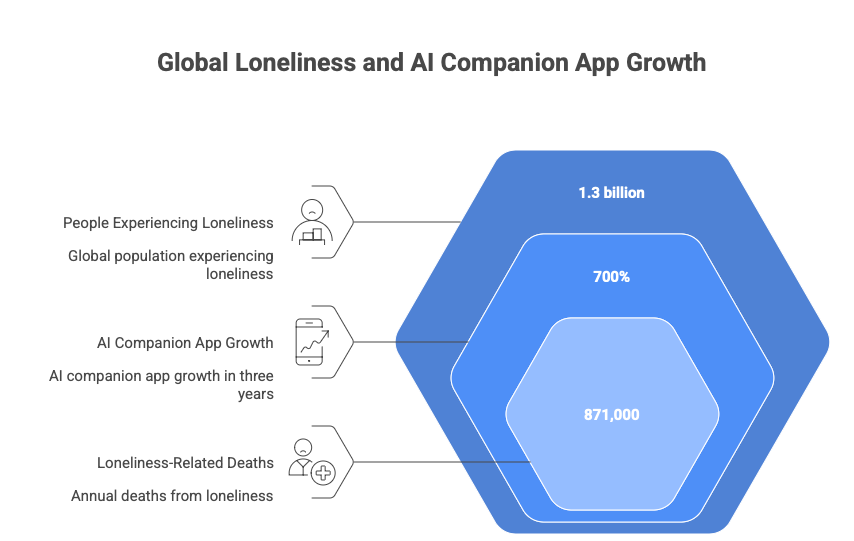
The Loneliness Economy: When Belonging Became a Subscription
Here's the uncomfortable truth nobody in a boardroom wants to say out loud: loneliness has become one of the most profitable industries of our time. According to a Fortune deep-dive on the loneliness epidemic, Gen Z and Millennials are driving a $460 billion loneliness economy globally—and India is among its fastest-growing markets. Rent-a-friend apps. Paid companion call services. AI "relationship" bots that remember your birthday. These are not irrelevant anymore or any “fringe” products. They have been scaling fast and have been mainstream lately.
The cruel irony? The same tech cloud platforms were supposed to make us feel more connected, but instead they create a loop of engagement that actually mimics the connection without delivering an actual one. You scroll. You like it. You get a dopamine hit. But when 2 AM arrives and you're feeling lonely and overwhelmed—the algorithm has nothing for you. That's not any kind of bug that you have been seeing. That's how the design has been made. And the guidance as well as counselling industry, followed by AI companion industry along with the “human connection” startups, has been quietly earning in between these gaps that have been left behind.
You cannot subscribe your way out of loneliness.
"Why Do I Feel Lonely Even With People Around Me?" — The Question India Keeps Asking
This exact question is what has been getting the highest upvotes on platforms like Reddit and Quora. The answers, when they reveal themselves, show that no wellness app has yet figured out how to resolve or fix this! As loneliness is not about the number of people that are present around you, it's actually about whether they can actually see you.
Here’s what people in India have been actually going through in the present times of 2026:
"I have 800 followers on Instagram but nobody seems to care about me or check upon me, when I have been feeling anxious at 2am. It already hits a different state of mind as soon as it all seeps in."
"My occupational burnout is an all-time high quotient for me.” Everyone tells me to “take a break," but nobody actually sits with me to have a conversation with me. That's the part that actually drains me.”
"I'm in the process of revealing my identity, or also you can say it's 'coming out of the closet,' and I have zero bandwidth. Whom do I need to have a talk with about this? My family would not cater to me and just shut me down. So I just take it and move it all alone!
"My toxic friendship group has been literally my only go-to socializing spot. I feel completely lonely when every single day I go without engaging with them, and it feels terrifying at all levels.”
These aren't edge cases. These are your neighbors, your college batchmates, and your colleagues at the desk next to yours. This is India — exhausted, connected, and quietly falling apart.

"How Do You Deal With Depression When You Can't Afford Therapy?" — What 10,000 Upvotes Tells Us
On Quora, questions like "how do you deal with depression" and "what is emotional exhaustion" have been pulling in thousands of upvotes as well as views every week. The answers that are written are either incomplete or patchy and not as asked, which feels dangerously personal. After which, people have been turning into AI companion apps along with paid call services and anonymous Reddit threads not because they believe in transactional bonds but because they are in desperate need of attention and also real talk of guidance and counseling as they simply don’t know where to start going.
The scary part is what happens when the searches come up with no results or are blank. As we know, relationship problems spiral. Workplace stress has been bleeding into every corner of life. And the tools people reach for—doom-scrolling, how-to-stop-overthinking threads at midnight, AI chatbots—offer relief that lasts about as long as the conversation window stays open. The good news, and there is good news: knowing you need support is already the bravest step you can take. The rest is in the right room.
Lonely in Luxury: When ₹6,000 Buys You a Daily Phone Call
Here's something that genuinely made people stop mid-scroll: a 27-year-old reportedly offered $6,000 — roughly ₹5 lakh — for daily companionship calls. Not therapy. Not dating. Not a coach. Just someone reliable to talk to. Every day. That single story has cracked something for opening conversations in modern times about loneliness, as it made one thing impossible to ignore: they are not those people who have been struggling financially or socially, as isolation does not care about salary.
Think about the Indian professional navigating workplace stress at a top-tier firm, handling how to handle parental pressure from a family that still expects a certain version of their life, and carrying unresolved relationship problems into a home that should feel like a refuge but doesn't. The loneliness inside that life has been quite real as well as heavy, and this burden seems like it's not just a performance review or hike in salary that will never be touched. When tech has been replacing every human form, which involves friction as well as convenience, the one thing that has not been still replaced by any AI is the one that only requires the presence of a genuine human witness. And we have been paying literally every second to find that perfect match every single second.
Does tech-driven connection make us lonelier than before? The data says yes — and so does the gut of anyone who's ever put down their phone and felt the room get quieter.

"Is It Normal to Prefer Talking to an AI Over Real People?" — Reddit, 4.2K Upvotes
The answer, increasingly, is yes—and that should worry all of us. Not because the people have been broken, but the conditions have been present that tend to make zero judgements. AI feels safer to people than real humans because this denotes a massive systematic failure. When real relationships involve too many risks—which is how to overcome trust issues; too much trauma, too many relationship counseling-worthy conversations that actually never took place—then AI starts to feel like a breath of fresh air.
Here's what top upvoted answers have consisted of:
AI can actually understand and comprehend what you are going to say, but still it can't truly witness you—and being understood in real life is what humans genuinely crave.
The relief has been real but yet temporary—like putting a band-aid on a wound that actually needs deep stitches and lots of healing.
What people actually need is real guidance and counseling—human, warm, without clinical sterility or judgment.
Learning how to relieve stress quickly actually just helps to get over the vulnerable moment, but its healing source is not the same.
The loneliness of a toxic friendship or a trauma-attached relationship is often what actually keeps people always going to AI because of their exhaustion and not just laziness.
Loneliness Is Bigger Than We Think — And It Is Not Just a Mental Health Problem
Here is the part that most health topics in India still are not touching: loneliness is not just any mental health issue. It is often the root condition underneath all of them. We have been treating anxiety as an isolation factor also in case of burnout. We actually give people tools for how to stop overthinking but don't even care to talk to them or know their thoughts and questions. Why don't thoughts like this have any safe place to land? And we wonder why nothing sticks.
Look at how it actually plays out:
Struggling with how to handle parental pressure? Without any ability to know how to process this, that pressure has no place to flow to—so it starts building inside, which turns into anxiety or also is known as resentment or both at the same time.
Dealing with a toxic friendship group? Loneliness is the exact reason most people stay—because a draining connection still feels better than the alternative of nothing.
Navigating relationship counseling after a difficult breakup? Social isolation makes every step of that recovery twice as slow and twice as painful.
Trying to understand how to overcome trust issues? Trust is the backbone of any relationship, and if there has been no relationship to talk to, then healing stops completely.
Occupational burnout and workplace stress? Both are deep-rooted problems, where there is no one at the workplace or at home who actually knows your burden.
India's loneliness epidemic is not only about feeling lonely when it's a Friday or a Saturday night! But it's a structural problem that resides within our homes, office space, friendships, relationships, and also ourselves. And no matter how much you doom scroll or try to swipe up, all these feelings cannot solve this structural mindset or the problems.
"Figuring out these patterns isn't about finding someone to blame. But clarity is where healing begins."

You're Not Imagining It—This Is What Loneliness Actually Looks Like in India Right Now
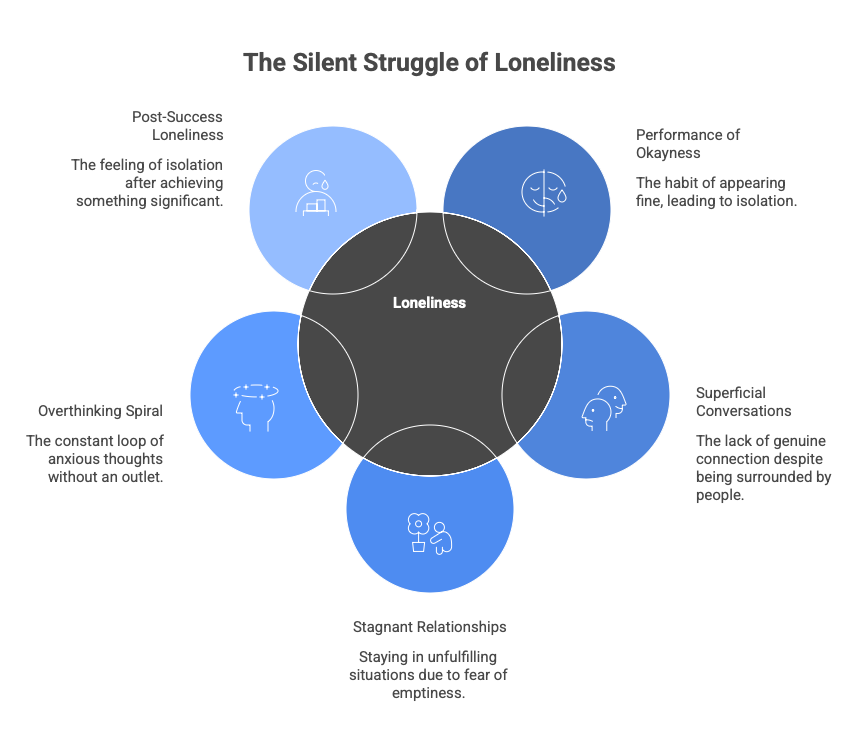
Loneliness does not always look like it's about just sitting all alone, be it in the dark room, but also the feeling of emptiness or hollowness inside that you never seem to take off. In India, it's full of life systems that involve full calendar bookings, group chats, and family homes—and still feeling lonely, which is something you can't even explain.
Here's how it actually sounds from the inside:
You perform being fine so that nobody tries to check upon you: The "I'm fine" has been exclaimed a lot many times, so much that everybody started to believe it! And now you have been feeling anxious about the day someone actually has a real talk, and you have to answer them with true honesty.
You're surrounded by people, but the conversations never go anywhere real: Family dinners, office lunches, WhatsApp groups with 200 people—and yet there is not one person you can call at 11pm and say, "I'm not doing well," without it becoming a whole thing.
You stay in things that have stopped helping you to grow because being alone feels worse: the toxic friendship you keep showing up to. The relationship problems You've stopped trying to solve. The workplace stress you absorb in silence. Loneliness is what keeps you tethered to the wrong rooms.
How to stop overthinking becomes your 2am Google search—every night: The spiral that has been happening because there’s no longer a safe space or person that can be handed that thought. So this thing goes round and round in a cycle, getting more vocal, where no one is left anymore to have a check-in done with you.
You feel most alone right after some exciting things happen in your life : a hike. A surprise getaway. A moment that you manifested and wanted for so long, and still, no one to share it with. This realization, in the very middle part of any day, is when this loneliness actually starts to hit you. This particular loneliness is one of the algorithms that are yet to be figured out how to maintain a relationship with.
Recognizing this isn't about panic. It's about finally calling the thing by its name—because you can't move toward connection while pretending the disconnection isn't there.
So What Do You Actually Do When Loneliness Has Been the Default for Too Long?
Here's the thing nobody tells you: you don't fix loneliness by being around more people. You fix it by finally being real with the right one. Whether you're the person quietly carrying this or the one noticing it in someone close to you—here's where it actually starts to shift.
Stop calling it something smaller than it is: not "I'm just an introvert" or "I'm picky about people"—but "I have been feeling lonely for a long time, and it has started costing me." That honest conversation that you have with yourself actually is what helps you. Everything else comes later.
Find one real conversation, not a hundred surface ones: The guidance and counseling that actually helps isn't the kind that gives you a five-step plan. It's the kind where someone actually sits with you to actually listen to your inner raw thoughts, be it someone with relationship problems, the anxiety, the coming-out conversation you've been putting off, or the parental pressure you've never said out loud, and doesn't flinch. That's the conversation worth having.
Interrupt the isolation loop before it becomes permanent: Loneliness compounds—the longer it sits, the harder it feels to overcome trust issues; the more the toxic friendship starts to feel like enough, the more how to relieve stress quickly becomes your entire strategy. Breaking this constant loop early on—even one conversation that is honest changes the whole tragedy more than any app ever.
Let someone actually know where you are: Not a vague "I've been off lately"—but the real thing. "I've been feeling disconnected for months, and I don't know how to get back. Said to the right person, that sentence does not actually start to feel like a burden. It's the beginning of not carrying it alone anymore.
You're Not 'Too Needy'—The System Is Disconnected
871,000 people a year. A $460 billion economy. A generation that scores 33 out of 100 on mental health. Behind every one of those numbers lies a real human being that is out there who has been feeling lonely and has had no clue where to exercise their loneliness. Moreover, many more people Googled, "How do you deal with being alone at night?" Who stayed in a toxic friendship because the alternative felt too empty. Who never found the right room, to be honest.
If that's you right now—feeling anxious, exhausted, wondering if this is just how life is—that's not a character flaw. That's a rational way to comprehend a world whose systems lack depth and are interchanged with convenience. And thus, reaching out for support, whether through relationship counseling, a real conversation, or just finally saying "I'm not okay" to someone who will actually stay, is where things start to shift. Because you cannot subscribe your way out of loneliness. But you can find your way back to reality.
Stop Performing 'Fine'. Start Finding Your Way Back.
Is your mind still running the loop—replaying conversations, wondering if things will ever feel lighter, and not knowing who to say any of it to? It's okay to acknowledge that this has started to feel like a lot. You don't need to fix everything at once. At times, you just need to vent—without being lectured, labelled, or judged.
No official diagnosis. No clinical vibes. Just a real human space to quiet the noise and reconnect with yourself.
Click here to connect with a Buddy who understands. No clinical vibes — just a meaningful conversation to help you feel stable again.
Frequently Asked Questions
Q: Is feeling lonely a sign something is wrong with me?
A: Not at all — it means your need for genuine connection hasn't been met, and that's worth paying attention to. Loneliness is data, not a flaw.
Q: Can relationship counseling actually help if I'm not in a couple?
A: Absolutely. Relationship counseling covers every relationship in your life—including the one with yourself. It's one of the most effective ways to work through trust issues, emotional exhaustion, and chronic disconnection.
Q: I keep Googling how to relieve stress quickly — what actually works long-term?
A: Quick techniques help in the moment, but lasting relief comes from being genuinely heard. That's exactly what TalkItOut is here for — no clinical distance, just a real conversation with someone in your corner.


Comments